By Ajayan Borys
Given Christmas Day, 2025 at Amritapuri Ashram
Gurur Brahma Gurur Vishnu
Gurur Devo Maheshwaraha
Guru Sakshat Parambrahma
Tasmai Shri Gurave Namaha
Salutations to our Beloved Satguru Amma, my brothers and sisters, and my daughters, Sudha and Ranjini, who are watching from the Chicago Ashram.
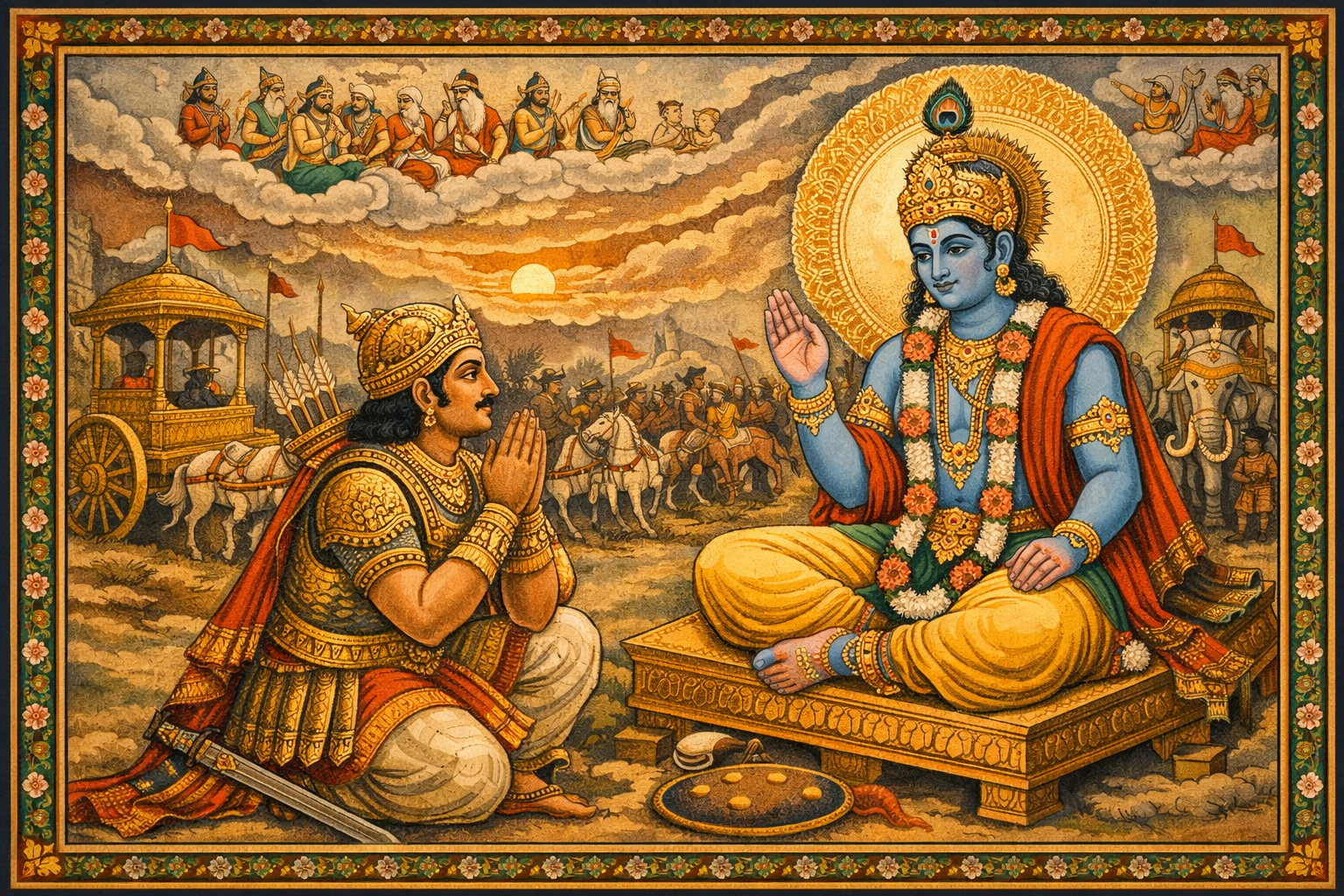
This past September, a few of Amma’s young children gave satsangs on verses 3-4 from Chapter 12 of the Bhagavad Gita. Their wonderful talks inspired me to contemplate the verses, and today I want to join them by adding a few points. Here are the verses:
ye tv akṣharam anirdeśhyam avyaktaṁ paryupāsate
sarvatra-gam achintyañcha kūṭa-stham achalandhruvam
sanniyamyendriya-grāmaṁ sarvatra sama-buddhayaḥ
te prāpnuvanti mām eva sarva-bhūta-hite ratāḥ
But those who worship the formless aspect of the Absolute Truth—the imperishable, the indefinable, the unmanifest, the all-pervading, the unthinkable, the unchanging, the eternal, and the immoveable—by restraining their senses and being even-minded everywhere, such persons, engaged in the welfare of all beings, also attain Me. Gita 12:3-4.
It strikes me that as devotees of Amma, we’re not so far from this path. When we sit with Amma, absorbed in watching her give darshan or sing, we are beginning to do just what this verse describes, even if we don’t see it that way. Perhaps we only need to add one word to this verse, so it becomes:
But those who worship the formless aspect of the Absolute Truth, Amma—the imperishable, the indefinable, the unmanifest, the all-pervading, the unthinkable, the unchanging, the eternal, and the immoveable—by restraining their senses and being even-minded everywhere, such persons, engaged in the welfare of all beings, also attain Me.
As I read that revised verse, maybe you thought, “No way! Amma is not formless. She’s so much nicer!” True. But still, there’s a deep equivalence between the path of Jnana as Krishna describes here and bhakti.
When we say Amma is so beautiful, isn’t it the brilliant light of divinity and divine love that animates Amma’s every smile, glance, and movement that imbues her form with such beauty? That divinity is:
So isn’t it the eternal, infinite formless we worship in Amma? Guru Sakshat Parambrahma: The Guru is the embodiment of Brahman.
In the Trika tradition of Kashmir Shaivism, there’s an important trio of concepts that I’ll apply to Amma:
So Apara, Amma’s form, is a doorway to experience Her divine qualities, Parapara. In turn, parapara is the doorway to realize Para, the transcendent formless supreme value of Amma, the supreme transcendental value of the Goddess, which is one with Shiva. So, we can meditate on Amma’s form, which allows us to feel Her divine essence and divine love, and in time this will allow us to merge in Her Being, Para.
This is a useful understanding, so we never mistake apara, Amma’s merely physical form, for the source of her beauty. Para is the Source and parapara is the radiance manifesting through apara, her body.
Advaitic Tantric systems such as this one integrate features of both Bhakti and Jnana, as well as Yoga philosophy and practices. We all have a heart, an intellect, and a mind, so an integration of Bhakti, Jnana, and Yoga is a practical and natural reflection of our nature as human beings.
So hopefully this makes clear why Bhakti is not far from Jnana. Not that the path of devotion to Amma is EXACTLY the same as the path of Jnana. Bhakti is the fruit of the full heart, Jnana is the fruit of the awakened intellect. Still, there is a profound equivalency between them.
To give an example of this principle, I’d like to share a personal experience. Lately, I’ve been doing face-wiping cloth seva. It is this seva that inspired this satsang. In a word, the air around Amma, in which the atoms of divine consciousness and love are so enlivened, is the easiest atmosphere in which to taste Brahman. As I mentioned a moment ago: Parapara in the form of Amma’s divine radiance, is the doorway to realizing Para, which for me is Brahman.
For a little background, before I continue with the face-wiping seva story: I have always been attracted to the formless ever since I was in high school. In 1970 I momentarily merged in the Absolute and ever since have known the ultimate to be the formless Infinite. Then, in February 1996, Amma introduced me to the Ribhu Gita, which is a scripture of pure Advaita.
You may wonder, did Amma actually give me the Ribhu Gita? Yes. Did she tell me to read it? Yes. But I say that because I have come to the conclusion that everything that happens in this ashram is Amma’s doing. If a crow wakes you up, it’s Amma saying time to go to Archana, or to get out of bed and meditate, because she’s meditating in her room and wants you to join her on the subtle.
So in 1996, I was living here, and my wife at that time gave me the Ribhu Gita for my birthday. How did she find that book and have the thought to give it to me? She was guided by Amma. I say this because it was more than just a book. It forever changed my sadhana. It was an initiation. So of course it was Amma.
So, as I’m handing out the face-wiping cloths on stage, it’s like the food prayer, Brahmārpaṇaṁ brahma havir … Amma is Brahman, my own consciousness, the room is Brahman, the face cloths are Brahman, as is each person. Consciousness isn’t confined to the limits of my body. It’s subtler than the subtlest. Nothing can contain it. It’s all-pervading. There is not one nook or cranny or atom in all the universe where consciousness is not. Your consciousness is all this. It is all Brahman, your very Self, my very Self.
This is not always clear to me, but it’s by far easiest to taste this in Amma’s divine presence as nowhere else. The sublime atmosphere around Amma melts boundaries. It is a fount where you can freely drink divine love and Brahman. And as Amma blesses me with her occasional glances that drive her chit-shakti ever deeper into me, that Reality becomes clearer.
This is the miracle of Amma’s presence, and why I say from experience, there is an equivalence between the path of Jnana and devotion to Amma. For me, bhakti to Amma and Jnana are one.
This is summed up in the simple mantra Amma teaches us: Ma Om. With this mantra, she describes this path in code: Ma Om, Shakti-Shiva, Bhakti-Jnana, Ma Brahm, two sides of one wholeness of life. With this mantra, we merge our consciousness into Amma’s.
Now back to the Gita verses. So verse 4 continues:
By restraining their senses – Not long ago, Ramesh Guntha gave a satsang that mentioned analogies Amma uses to encourage us to conserve spiritual energy. Among others, he said chasing sense objects is like:
We all know this. This applies to all sadhaks, no matter what their path.
Being even minded everywhere – For the Jnani, this is primary, but so is it also for the Bhakta. Amma teaches us to see all as the Self or as Her, and to regard all beings with compassion and love. That is the even-mindedness of a full heart.
Engaged in the welfare of all beings— The Jnani who no longer identifies with his own body but rather with all creation cannot but serve the welfare of all beings. He is all beings. So with every interaction, he serves others spontaneously. The universal intelligence naturally uses him in this way. For Bhaktas, Amma emphasizes selfless service. As we mature, this service also gets spontaneously expressed in all our interactions through love.
So where is the big difference between Bhakti and Jnana?
If anyone still wonders whether this is true, I have another personal story.
In October of 2023, I gave a satsang on meditation. You know how people say, Amma please correct me if I make any mistakes? I also said that, but Amma didn’t interrupt my talk to correct me. So I figured I must have totally nailed it! A perfect satsang! But the next night as I ate after bhajans, Amma blessed me with some important corrections that I’ll never forget.
I had talked about the Devas in my satsang. So the first thing she said: the Devas aren’t separate from you. The Devas are your own Self. She said we should see them as our own good qualities. She was definitely responding to my satsang. How often does Amma talk about Devas? I realized how foolish I had been to talk of the Devas as if they were separate from me. The Devas are none other than impulses of our consciousness. So Amma was giving me an important Advaitic reminder.
Then she said two things that changed my very concept of meditation and samadhi. She said real samadhi is not being in an altered state of absorption. Such a state is like sleep in that when you come out, you’re the same as before. Even reaching such a state, you may come out and still lose your temper, like Vishvamitra. She said real samadhi is shamatha, equanimity.
Amma went on to say real samadhi is a shift of perspective. You should ask yourself, are you in the room or is the room in you? When the room is in you, you have shamatha, and your peace can’t be shaken.
Well, we all know Amma has a way of saying just what you need to hear when you need to hear it. And she may speak in a kind of secret code that seems meant just for you. I had dedicated myself to achieving that first kind of samadhi. For years I had sat in one layer of samadhi or another for hours every day. And yet just a month before coming to Amritapuri in 2023, I had lost my temper completely at a customer service rep on the phone. Though I immediately apologized to the person, I felt ashamed.
Because I felt so bad, I told my wife at that time, about it. She is a Tibetan Buddhist. They highly prize equanimity, shamatha. She had previously pointed out to me that I still got angry and needed to work on that. Mostly I had ignored her. But on the day I lost my temper, I confessed to her that she was right and I was wrong to have ignored her: I clearly had work to do.
Now, as I listened to the translation of Amma the night after my satsang, I couldn’t help but wonder, why had she chosen the Buddhist term, shamatha? Why didn’t she pick a term from our tradition? Amma sounded just like my wife! I even looked it up to see if it was actually a Hindu term too, but no, it was Buddhist. Then I knew: Amma was in cahoots with my wife. For sure! She was letting me know she knew all about me losing my temper and my confession.
Clearly, Amma wanted me to gain equanimity, and she was telling me exactly how to do it: to shift my perspective so I am not in the room but the room is in me. She was also telling me why I had not achieved it yet. You can have lots of bliss from meditation, lots of prajna, insight, but if you’re still in the room, you lack evenness of mind. Even Patanjali refers to this in the 11th verse of Chapter 4 of the Yoga Sutras: Vyasa’s commentary clarifies that the refuge of Vasana is the fluctuating mind. He says what is needed to eliminate vasanas is to remove their refuge, the fluctuating mind. So yes, as Amma said, I needed Shamatha, the calm, equanimous state.
Now, this metaphor of the room being within you is also profoundly advaitic. Really it’s more than a metaphor, because it describes an actual state of being, that the room is within you. But if I have understood Amma correctly, it doesn’t stop at the room. You are not in the body, the body is within you, the room is within you, the world is within you, all this creation is within you. This is the real goal of meditation: Brahman.
What is Brahman? This certain knowledge that all creation is permeated and encompassed by the great wholeness of awareness that is your very Self. It all IS your Self. That is “being even-minded everywhere” as Krishna says in verse 4. Realization of Brahman is Shamatha to the infinite degree.
So that night, with those few words to everyone in the hall, I felt like Amma had me alone in an initiation room and imparted the secret knowledge of the ultimate goal of meditation. It is not the fourth state, nirvija Samadhi, which had been my gold standard ever since momentarily merging into the Absolute in 1970. That state is only a preface. It’s like a 2-dimensional drawing of the actual goal, which is the all-encompassing wholeness of Brahman.
I don’t know whether Amma said this about the room being within you only that night or many times before. That was the first time I had heard it. For me, that night was my initiation into Brahman by my beloved Guru, Amma. I felt she planted the seed that will one day grow into a tree.
A couple of days after Amma had made those comments on my satsang, I went to her for my last darshan because I was about to return to the US. As I approached her, I knew I could only surrender to her completely. Decades of self effort had fallen short. I had only one option left: Amma.
As she gave me darshan, she whispered in my ear a word I had never heard before: Kutastha, Kutastha, Kutastha.
Later I looked it up: that which is unchanging. There are other Sanskrit words for unchanging, but Kutastha has a special meaning. In fact, Kutastha appears in this very Gita verse I am speaking of tonight, verse 3. Shankara in his commentary points out that Kuta means something that seems good but is not. It is deceptive. So he defines Kutastha as the unchanging controller or witness of maya, the ultimate deception. So yes, that was exactly what I needed. Kutastha, beyond the changing mind that is the refuge of vasanas and maya.
And now I can correct my earlier statement that Amma is merely the Unchanging. More precisely, who can doubt she is Kutastha, the unchanging controller of Maya and witness of all our vasanas.
As I came away from that darshan, I knew my liberation was entirely in Amma’s hands. It’s beyond me, but not beyond her. I can only surrender. So again, there is an equivalence between devotion to Amma and the path of Jnana. Am I on the path of devotion or the path of Jnana? Both. For me, they are one.
How blessed we are to have Amma, who is the final Goal of all paths and who can dole out fulfillment to her disciples with a glance, a single word, or by even a thought. Offering these words, which Amma herself put into my mind, to Amma’s lotus feet. Om Namah Shivayah!